


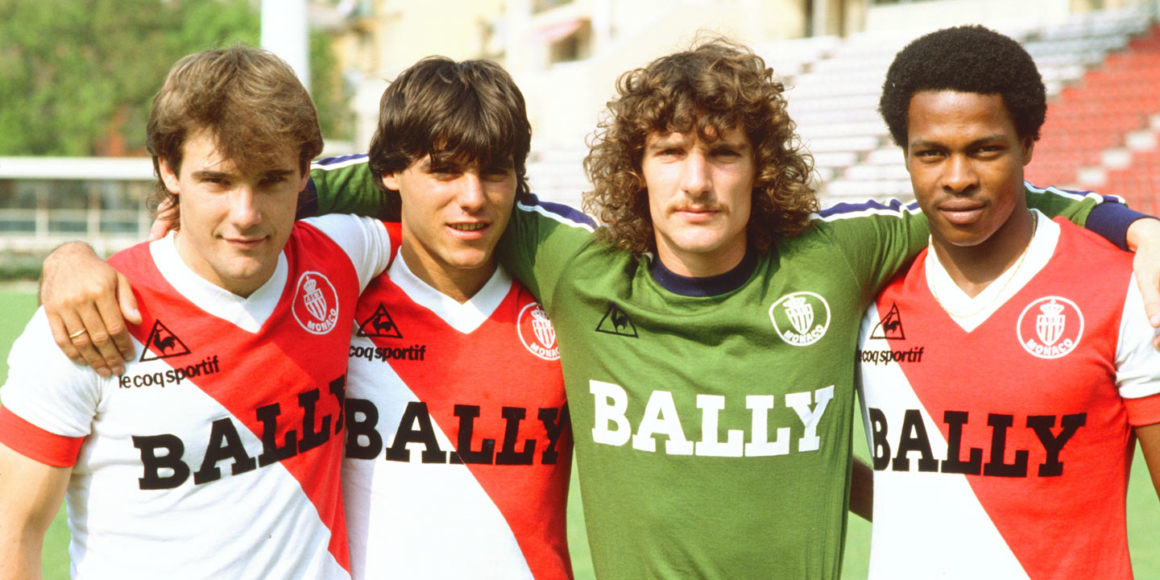
While the first results of Monaco's youth academy were quickly evident following its creation and under the direction of Gérard Banide, notably with the arrival of Jean-Luc Ettori and Claude Puel, two future club legends, to the first team, the project also began to expand. President Jean-Louis Campora recruited two more renowned coaches, with the arrival of Paul Pietri in 1980, closely followed by Pierre Tournier in 1982.
Pierre Tournier, Sochaux's expertise 💎
He arrived at the foot of the Rock from FC Sochaux with a solid reputation, having launched players like Joël Bats, Yannick Stopyra, and even the future Monaco player Bernard Genghini, as Norbert Siri recalls in his book dedicated to AS Monaco's centenary. The guiding principle? To try to replicate the Franche-Comté club's model by providing proper infrastructure for the young players at the academy.
If I have succeeded in instilling in my young players humility, an appreciation for beautiful football, for creative football, an almost chivalrous respect for the opponent as a playing partner, if I have succeeded in teaching them that football is not defined by positions, duels, or tackles, (...) If I have succeeded in making them not only professional footballers, but above all, men of integrity, then yes, I can say that I have accomplished my mission.
Pierre Tournier, in Daghe Munegu - The Encyclopedia of AS Monaco FC by Norbert and Julien Sir
Paul Pietri, education first 🏫
It was with this in mind that the pre-training center was created, reserved for teenagers who joined the Principality at the age of 15, and whose management was entrusted to Paul Pietri. At the same time as the Academy's management was being structured, the new Stade-Louis II was inaugurated by Prince Rainier III on January 25, 1985, a stone's throw from the old stadium of the same name, which had been built in 1939.
The Stade Louis-II, more than just a refuge 🏟️
More than just the home of the first team of the Monaco club, this ultra-modern, multi-purpose stadium now also housed the Academy's young players on a daily basis. Indeed, since late 1984, these young Monegasque talents stayed in individual rooms within its walls, eating their meals in the cafeteria, and attending classes in dedicated classrooms.
I set to work, drawing inspiration from the Sochaux model. It is undoubtedly the infrastructure of the new Stade Louis-II, its individual rooms, its cafeteria, its classrooms, that has allowed AS Monaco to now possess one of the most efficient training centers in France and thus ensure high-quality recruitment by attracting the best young players in the country.
Pierre Tournier, in Daghe Munegu - The Encyclopedia of AS Monaco FC by Norbert and Julien Siri
First successes, second generation 🏆
While the two standard-bearers of the Rouge et Blanc academy, Manuel Amoros and Bruno Bellone, were crowned European champions with the French national team (1984), with a goal from "Lucky Luke" in the final, the second generation of raw talent was making its mark within the youth system. It was in this context that Paul Piétri, Pierre Tournier, and Gérard Banide welcomed and successively developed players such as Patrick Valéry, Emmanuel Petit, and Bruno Rodriguez.
More info about

See also
-
 Photos The Rouge et Blanc gearing up for their UEFA Conference League opener in SofiaGallery 23 photos
 -
 Photos Relive the duel between the Rouge et Blanc and Toulouse through the best imagesGallery 40 photos